

Direct-to-employer contracting is changing how employers pay for care, and orthopedics is where the model is proving itself first. When a self-funded employer contracts directly with providers for a defined set of services at a known price, everyone gets clarity: the employer knows what it will spend, the provider knows what it will be paid, and the employee knows where to go.
Employers pay for a large share of American healthcare. Yet for most of the history of employer-sponsored coverage, they’ve been a step removed from the care itself. They pick a network, pay the claims, and hope the cost curve bends. It rarely does. That’s starting to change.
What is direct-to-employer contracting?
Direct-to-employer contracting is an arrangement in which a self-funded employer contracts directly with a provider or provider network for specific services, at an agreed price, with clear quality expectations. Instead of relying only on a traditional network and fee-for-service claims, the employer purchases defined episodes of care.
Most programs use bundled pricing: one upfront price that covers the full episode, from the pre-op visit through the procedure and follow-up care. For providers, it’s a chance to compete on value for a population that has been hard to reach on those terms. For employees, it can mean a simpler experience: one price, a clear path to a high-quality provider, and no surprise bills afterward.
Why self-funded employers are going direct
Self-funded employers already carry the financial risk for their members’ care, which gives them both the motive and the flexibility to contract differently. According to the KFF 2025 Employer Health Benefits Survey, 67% of covered workers are enrolled in self-funded plans. That’s a large share of the commercial market where employers, not insurers, decide how care is purchased.
Cost pressure is doing the rest. Employers facing another year of rising premiums want arrangements where price and quality are defined up front, not discovered after the claim arrives. Direct contracting gives them that predictability, and it gives providers a direct relationship with the organizations paying for care.
Why orthopedics and MSK care are leading the shift
Direct contracting works best where care is high-cost, plannable, and well-defined. Orthopedic and musculoskeletal care fits all three. A knee replacement or spinal procedure has a recognizable start and finish. Its costs vary widely from one provider to the next. And its outcomes can be measured.
MSK is also one of the costs employers watch most closely. In the Business Group on Health 2027 Employer Healthcare Strategy Survey, employers ranked musculoskeletal conditions second only to cancer among their top cost drivers. High spend, predictable episodes, and measurable results make orthopedics a natural place for employers to start, and for providers to prove what they can deliver.
Three things that make direct contracting programs scale
Direct contracting sounds simple, but operationalizing it is where most programs succeed or stall. In my view, three things separate programs that scale from those that stay pilots.
Bundles built for how care actually happens. A good bundle covers the full episode, including pre-op, the procedure, and post-op follow-up. It is priced in a way that holds up for both the provider and the employer.
An experience employees will actually use. If finding a provider and purchasing care is harder than the old way, adoption suffers no matter how good the price is.
Payments and contracts that don’t recreate the old complexity. Simple contracts and fast, predictable payment are a big part of why providers want to participate in the first place.
None of these are glamorous. They are operational problems, and they are the ones we spend our time on at Tendo: packaging bundles clearly, making care simple to purchase, and settling payment quickly so providers can focus on care.
What direct contracting means for health systems and specialty groups
Direct contracting isn’t a replacement for payer contracts, and it won’t transform a service line overnight. Its value comes from execution. Health systems and specialty groups that treat direct contracts as a real channel, with well-designed bundles, clear quality data, and a simple path for employees, are positioned to earn volume that rewards them for delivering value.
Groups that treat it as a side project tend to stall at the pilot stage. The organizations moving now have an advantage: they are building the employer relationships, pricing discipline, and operational muscle that more employers will look for as they go direct.
Watch the replay: hear it from the people building it
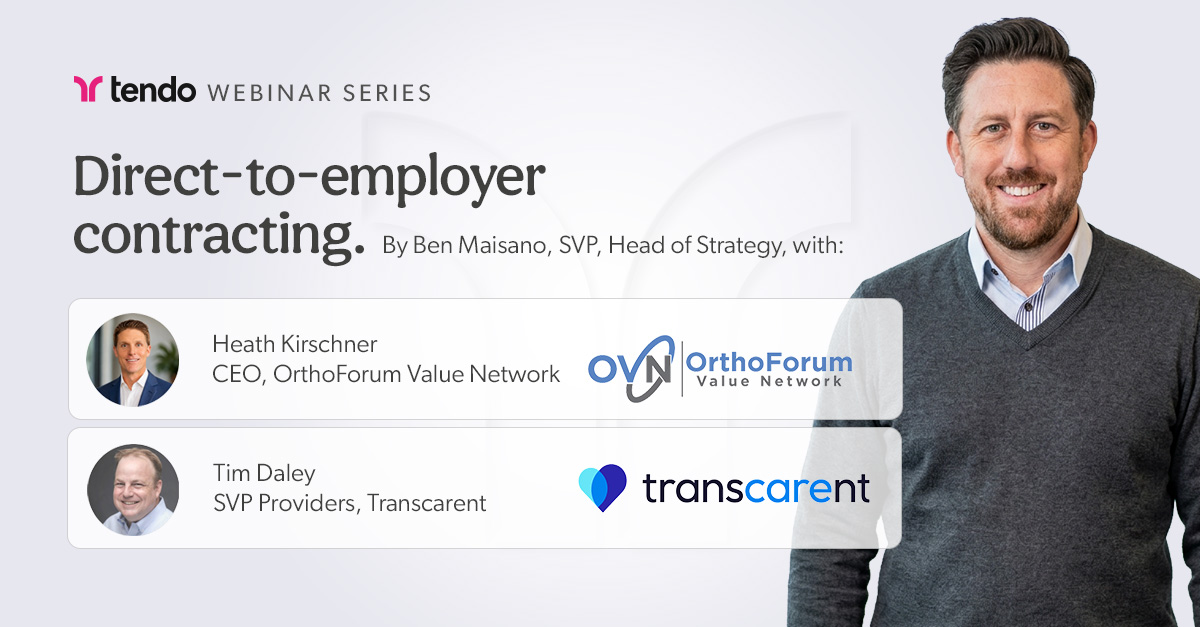
We brought together leaders who work on this from every side of the table. Heath Kirschner, CEO of OrthoForum Value Network, brings the perspective of independent orthopedic groups. Tim Daley, SVP Providers at Transcarent, speaks to how employers and their members experience direct care. Eric Makovsky, Tendo’s EVP of Customer Solutions, joined me to cover what it takes to run these programs day to day.
The panel covers:
- Why direct-to-employer contracting is growing
- Why orthopedics is at the front of the shift
- How to build effective procedure bundles
- How to make programs easier to use
- How to simplify payments and contracting
- Where the market is headed next
If you lead strategy, service lines, or contracting at a health system or specialty group, this is a conversation worth your time. It’s available on demand, so you can watch on your schedule.
Frequently asked questions about direct-to-employer contracting
What is direct-to-employer contracting?
Direct-to-employer contracting is an agreement between a self-funded employer and a provider or provider network for defined services at a set price. It typically uses bundled pricing and clear quality expectations, rather than fee-for-service claims through a traditional network.
Why is orthopedics leading the shift to direct contracting?
Orthopedic procedures are high-cost, plannable, and well-defined. Prices vary widely between providers, and outcomes can be measured, which makes orthopedics a practical starting point for employers and a clear way for providers to show value.
What does an orthopedic care bundle include?
A well-built orthopedic bundle covers the full episode of care: the pre-op visit, the procedure itself, and post-op follow-up. The employer and employee see one upfront price for the whole episode.
How is a direct contract different from a traditional network?
In a traditional network, employers pay claims after care is delivered at rates set through intermediaries. In a direct contract, the employer and provider agree on the services, the price, and quality expectations before care happens.
Who should watch the webinar?
The panel is designed for leaders in strategy, service lines, and contracting at health systems and specialty groups who are evaluating or building direct-to-employer programs.
Watch the full webinar to see the future of employer health in action.
Get in touch with us today!
Learn more about Tendo Marketplace
Empowering health systems to deliver care that’s accessible, affordable, and consumer-first.